Water Conservation Tips for Southern California Homes
Water Conservation, Southern California, Homeowner Tips
What Homeowners Should Know About Water Usage in Southern California
Living in Southern California means enjoying abundant sunshine, diverse neighborhoods, and vibrant outdoor spaces—but it also means learning how to manage water wisely. As drought awareness grows and long-term climate patterns shift, understanding your home’s water usage and adopting sustainable practices is no longer optional; it’s part of being a responsible homeowner in the region.
Why Water Conservation Matters More Than Ever
Even in years that feel “normal,” Southern California sits on the front lines of a drying climate. As of late August 2026, federal drought monitors reported that about 41% of the California–Nevada region was in drought and another 39% was abnormally dry, with Southern California’s high summer temperatures pushing water demand even higher (drought.gov). At the same time, statewide reservoir storage hovered around 68% of historical averages in September 2026 (California Water Watch).
For homeowners, this means that water conservation is not just a temporary response to emergency drought declarations; it is a long-term way of living. State law now backs this up. Through the “Making Conservation a California Way of Life” framework (SB 606 and AB 1668), urban water suppliers must meet ongoing efficiency targets for indoor and outdoor use and report progress each year (water.ca.gov). Your household water habits directly influence whether local agencies meet those goals—and how resilient your community will be in the next dry spell.
📌 Key Takeaway: In Southern California, drought awareness should be a year-round mindset, not just a reaction to headlines about dry winters.
Where Southern California’s Water Comes From—and Why It’s Vulnerable
Southern California relies on a complex mix of imported and local supplies: water from the Sierra Nevada via the State Water Project, the Colorado River, regional groundwater basins, recycled water, and increasingly, desalination. In 2026, the State Water Project delivered roughly 8 million acre-feet of water to the Southern California area alone (DWR Bulletin 132‑25), serving millions of residents and businesses.
These imported sources are under stress from hotter temperatures, changing snowpack, and long-term over-allocation. That’s why state and regional agencies—from the Metropolitan Water District to local cities—invest in conservation, recycling, and drought planning. As a homeowner, your day-to-day water usage choices are part of this bigger regional picture.
Understanding Your Home’s Water Usage
The latest statewide data show residential water use averaging about 63 gallons per person per day in early 2026 (State Water Resources Control Board). Many urban communities in Southern California already use less than this, thanks to aggressive efficiency programs and building codes. Still, there is room to improve—especially outdoors, where up to 70% of urban water use can go just to landscaping in some neighborhoods (waterboards.ca.gov).
Indoor use typically includes showers, toilets, faucets, dishwashers, and laundry—areas where efficient fixtures and small habit changes can quickly reduce water usage.
Outdoor use often dominates in single-family homes: irrigation, pools, and outdoor cleaning. This is where the biggest long-term savings are possible through sustainable practices like drought-tolerant landscaping and smart irrigation.
💡 Pro Tip: Check your water bill for “gallons per day” or “hundred cubic feet (HCF)” and compare your usage to your water agency’s target or neighborhood average. That’s your starting point for change.
Indoor Homeowner Tips for Everyday Water Conservation
Indoors, water savings often come from small, repeatable actions and one-time upgrades. State conservation guidance highlights a handful of simple steps that every household can adopt (water.ca.gov):
Fix leaks fast. A running toilet can waste hundreds of gallons a day, and a dripping faucet adds up quickly. Test toilets with a few drops of food coloring in the tank; if color appears in the bowl without flushing, you have a leak.
Install high-efficiency fixtures. Look for WaterSense-labeled toilets, faucet aerators, and low-flow showerheads. These are designed to maintain comfort while cutting water usage significantly—and many Southern California agencies offer rebates to offset costs.
Shorten showers. Aim for around five minutes. Even trimming one or two minutes per shower can save thousands of gallons per year in a multi-person household.
Run full loads only. Wait until dishwashers and washing machines are full before running them. Modern appliances are most efficient at capacity, so you save both water and energy.
These indoor homeowner tips are low-cost and easy to implement, yet they support statewide goals for efficient water usage and align with California’s long-term conservation standards.
Outdoor Water Usage: Your Biggest Opportunity for Savings
In many Southern California neighborhoods, lawns and landscaping consume more water than everything inside the house combined. That’s why regional programs have focused so heavily on transforming yards. The Metropolitan Water District’s turf replacement efforts alone have converted more than 230 million square feet of grass, saving enough water to meet the needs of over 83,000 homes every year (waterboards.ca.gov).
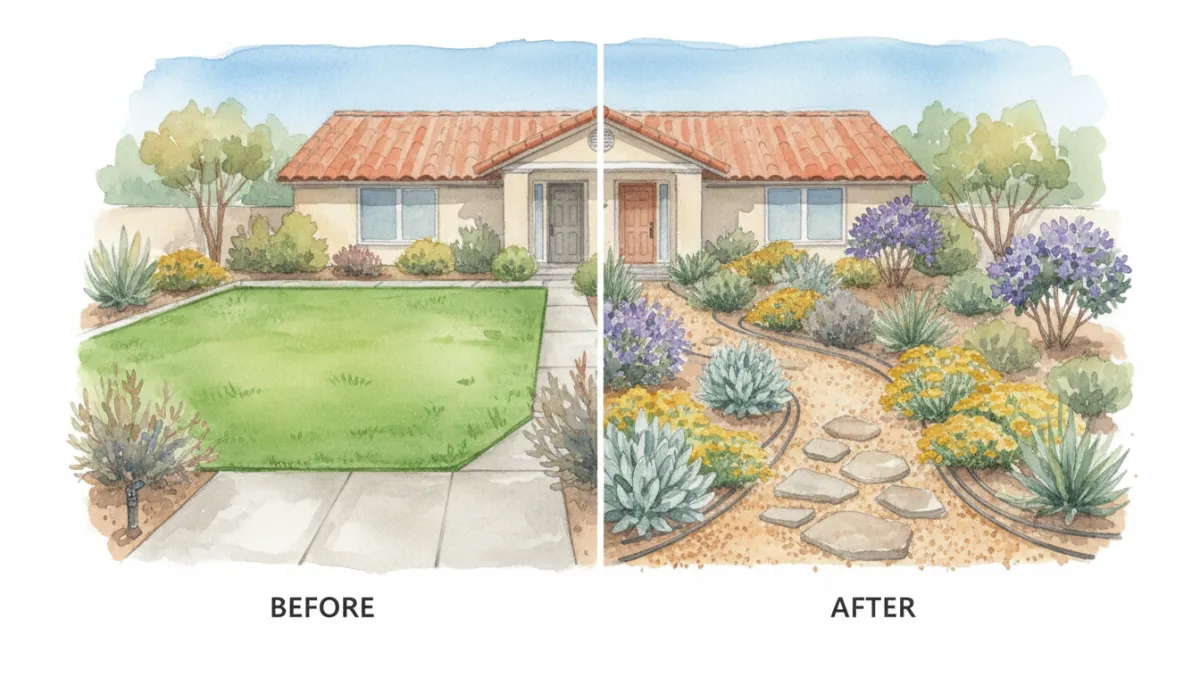
Replacing turf with native plants can cut outdoor water use by more than half.
Swap lawns for drought-tolerant landscapes. California-native and climate-appropriate plants can reduce outdoor water use by up to 60% (waterforla.lacounty.gov), while still providing color, shade, and habitat for pollinators.
Use smart irrigation. Water before 9 a.m. or after 4 p.m. to minimize evaporation, and never irrigate during or within 48 hours of measurable rain (a permanent rule in Los Angeles and many other cities). Consider weather-based controllers and drip systems to deliver water directly to plant roots.
Maintain your system. Inspect sprinklers and drip lines regularly to ensure they aren’t watering sidewalks or leaking. A quick monthly walk-through can prevent thousands of gallons of waste each season (UC ANR Smart Water Living).
Cover your pool. Pool covers dramatically reduce evaporation—a major source of water loss during hot, dry summers (waterforla.lacounty.gov).
💡 Pro Tip: Many water agencies in Southern California offer rebates for turf removal, efficient irrigation controllers, and even rain barrels. Check your local provider’s conservation or “rebates” page before starting a project.
Rules, Restrictions, and Long-Term Sustainable Practices
While statewide emergency drought rules—like the temporary ban on watering decorative turf—expired in 2024, many permanent efficiency standards remain. In the Los Angeles Department of Water and Power service area, for example, homeowners must avoid hosing down paved surfaces (except for health or safety), can only use decorative fountains with recirculating systems, and are prohibited from watering between 9 a.m. and 4 p.m or during and shortly after rain events (LADWP Water Shortage Contingency Plan).
Beyond complying with rules, you can embrace sustainable practices that make your property more resilient and comfortable:
Design landscapes that capture and store rainfall on-site with swales, contouring, and permeable hardscape, reducing runoff and supporting plant health during dry spells.
Consider graywater systems (where allowed by local codes) that reuse lightly used water from laundry or showers for landscape irrigation.
Choose shade trees wisely. Properly placed, drought-tolerant trees can cool your home, reduce energy bills, and lower outdoor water demand by protecting understory plants from intense sun.
Staying Informed: Drought Awareness and Community Efforts
Drought awareness in Southern California is supported by a growing network of campaigns and early-warning systems. NOAA’s Southern California Sector-Specific Drought Early Warning Pilot now issues regular outlooks for water utilities, agriculture, and public health (drought.gov). Public campaigns such as “Save Our Water,” the Southern California Water Coalition’s “Lawn Dude: Conserve, Conserve, Conserve!” effort, and local initiatives along the Los Angeles River keep conservation in the public eye year-round.
As a homeowner, you can tap into these resources for up-to-date homeowner tips, rebates, and workshops. Many agencies host free classes on drought-tolerant gardening, irrigation basics, and rainwater capture. Participating not only helps your own property; it also supports a culture of shared responsibility across Southern California communities.
Bringing It All Together at Home
Being a homeowner in Southern California today means thinking about water usage as carefully as you think about mortgage payments, insurance, or home maintenance. The good news is that many of the most effective water conservation strategies are straightforward and affordable:
Start indoors with leak repairs and efficient fixtures to lock in immediate savings.
Reimagine your yard using drought-tolerant plants, smart irrigation, and shade strategies for long-term, sustainable practices outdoors.
Stay informed about local rules, rebates, and drought conditions so your choices align with regional needs.
The region has already cut urban water demand dramatically over the last two decades through a combination of efficiency, recycling, and new supplies (California Research Bureau). By taking action at home, you join a larger movement that keeps Southern California livable, green, and resilient—even as the climate changes. Your yard, your fixtures, and your daily habits are powerful tools in protecting this shared resource for the long term.