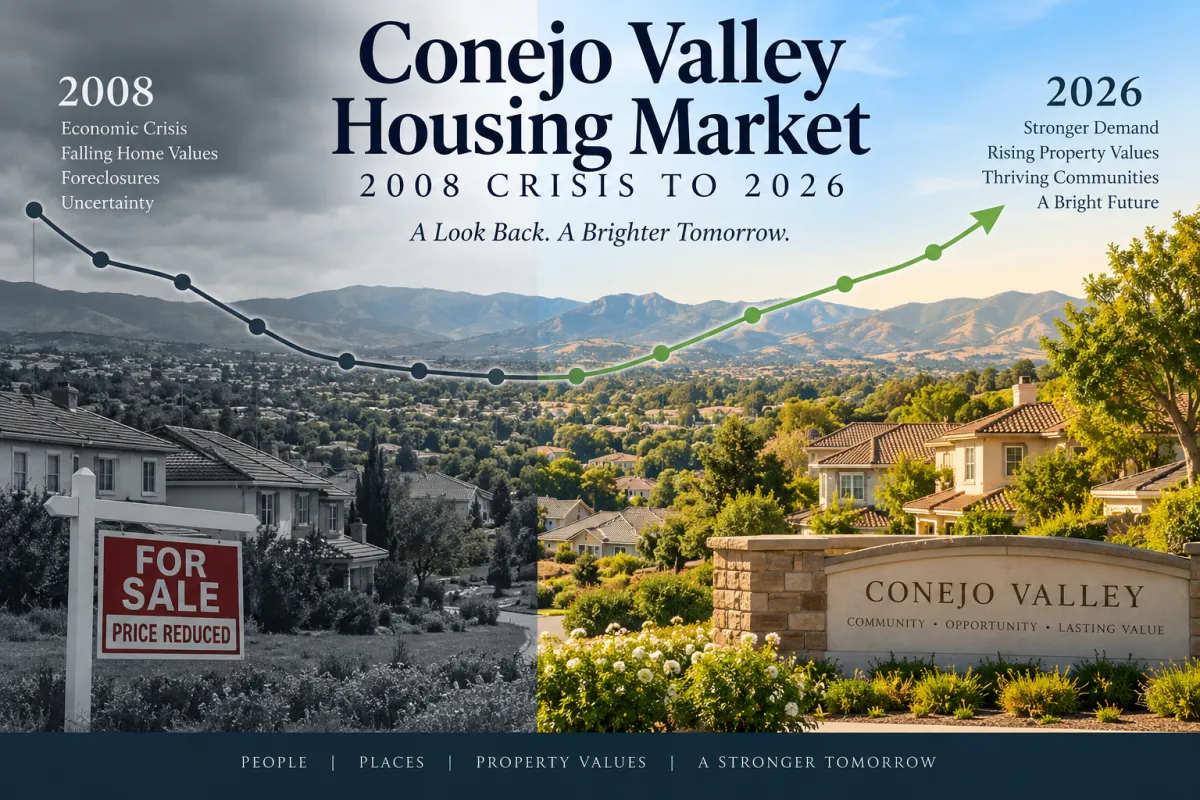
Conejo Valley Housing Market: 2008 Crisis to 2026
Conejo Valley, Housing Market, 2008 Housing Crisis, Real Estate Trends, Market Comparison, Property Values
From the 2008 Housing Crisis to 2026: How the Conejo Valley Housing Market Compares
Nearly two decades after the 2008 housing crisis, the Conejo Valley housing market tells a very different story—one of resilience, long‑term growth, and a new set of challenges for buyers and sellers. Understanding how today’s market compares to that turbulent era can help you make smarter real estate decisions in 2026 and beyond.
Looking Back: What the 2008 Housing Crisis Meant for Homeowners
To understand today’s Conejo Valley housing market, it helps to remember what happened during the 2008 housing crisis. Nationally, loose lending standards, speculative buying, and an overheated real estate market led to a wave of foreclosures when adjustable‑rate mortgages reset and home values dropped. Millions of owners suddenly owed more than their homes were worth, and prices in many areas fell 20–40% from their peaks.
The Conejo Valley—covering communities like Thousand Oaks, Westlake Village, Newbury Park, Oak Park, and surrounding neighborhoods—did not escape the downturn. Property values declined, distressed sales increased, and buyers became cautious. Yet compared with many inland and lower‑priced markets, Conejo’s combination of strong schools, proximity to job centers, and limited land for new construction helped cushion the blow and set the stage for a faster recovery once the broader economy stabilized.
💡 Context: In 2008–2012, the national conversation centered on survival—avoiding foreclosure and waiting for prices to stop falling. In 2026, the questions are very different: affordability, timing, and how to navigate a high‑value, low‑inventory market.
From Crisis to Comeback: How Conejo Valley Rebuilt Its Market
Through the 2010s, tighter lending standards and a slowly improving economy allowed the housing market to heal. In the Conejo Valley, demand steadily returned, driven by families seeking highly rated schools, quieter suburban neighborhoods, and access to both Los Angeles and Ventura County job hubs. New construction remained constrained by geography and local planning, which limited supply even as interest in the area grew.
By the mid‑2010s, many homeowners who had been underwater during the 2008 housing crisis saw their equity restored. Prices climbed past pre‑crisis peaks. The pandemic years then added another layer: ultra‑low mortgage rates, remote work, and a renewed desire for more space and outdoor amenities pushed buyer demand—and prices—even higher, especially in desirable suburban markets like Conejo Valley.
The Conejo Valley Housing Market in 2026: A Data‑Driven Snapshot
Fast‑forward to mid‑to‑late 2026, and Conejo Valley looks nothing like it did in 2008. According to Realtor.com, the median listing and sold price in August 2026 both stood at about $1,039,000, with a price per square foot of roughly $525. That represents a slight year‑over‑year cooling—listing prices are down about 3.35%, and price per square foot has dipped around 1.9%—but values remain elevated compared with the broader Ventura County median of roughly $877,000–$883,000 reported by Redfin and Zillow.
Inventory remains tight. In August 2026, there were only about 167 active listings in the Conejo Valley, down nearly 5% from a year earlier, though slightly higher month‑to‑month. Homes are selling quickly: the median time on market is just 37 days, almost 18% faster than last year, reinforcing that this is still a seller’s market, even as growth moderates. The rental side is similarly strong, with median rents around $4,550 per month and limited available units.
Tight inventory and quick sales keep well‑located Conejo Valley neighborhoods in high demand.
Market Comparison: Conejo Valley vs. Ventura County and California
When you step back and look at real estate trends across Ventura County and California, the Conejo Valley clearly stands out. Countywide, median listing prices hover around $962,000, with median sale prices closer to the high $870,000s, depending on the data source. The California Association of Realtors projects a statewide median home price of about $905,000 for 2026. Conejo Valley’s median around $1.04 million places it comfortably above both the county and state averages, underlining its reputation as one of the region’s higher‑value enclaves.
Yet the market is not racing away unchecked. Sotheby’s Q2 2026 report for the Conejo Valley and surrounding areas shows a median sales price of about $860,000, down roughly 7% from Q2 2025, and a sharp 33% drop in closed sales. Inventory also dipped by about 4%. These numbers suggest a market transitioning from the frenzied pace of the early‑2020s toward a more balanced, sustainable environment—very different from the boom‑and‑bust cycle that led to the 2008 housing crisis.
📌 Key Takeaway: Compared with the rest of Ventura County and California, the Conejo Valley commands higher property values but is also showing modest cooling—more of a gentle landing than a crash.
Neighborhood‑Level Real Estate Trends Across the Conejo Valley
While it’s useful to talk about the Conejo Valley housing market as a whole, buyers and sellers live at the neighborhood level. Recent 2026 data show meaningful differences between communities, even as overall trends remain consistent.
Thousand Oaks: Median sale prices have hovered around $1.1–$1.2 million in 2026, with inventory ranging from about 2.2 to 3.7 months of supply and average days on market near 40. This points to a steady, competitive environment where well‑priced homes still move quickly.
Westlake Village: This luxury‑leaning market has seen more volatility. Median prices dipped to around $1.27 million in May 2026, then rebounded sharply to roughly $1.9 million by late summer. Inventory sits near 3.2 months, and homes average about 57 days on market—slower than Thousand Oaks, but at much higher price points.
Newbury Park: With median prices around $1.11–$1.14 million and only about 2.0–2.5 months of supply, Newbury Park shows strong demand and relatively fast sales, averaging about 42 days on market. For many buyers, it represents a balance between price, amenities, and access.
Oak Park: Known for its schools and tight‑knit feel, Oak Park has very low turnover. Median prices have ranged from approximately $1.28–$1.4 million, with inventory as low as 1.8 months in some reports and around 2.8 months more recently. Average days on market are in the mid‑40s, reflecting strong but selective demand.
Rancho Conejo Village: This Thousand Oaks neighborhood has been a standout. For the three months ending March 2026, median sale prices around $1.338 million represented a striking 24.5% year‑over‑year increase, with homes selling in about 38 days—down from 64 days the year before.
These differences matter when you’re making a market comparison or evaluating property values for a specific home. A “Conejo Valley median” is helpful as a reference point, but your experience as a buyer or seller will depend heavily on the micro‑market you’re in, from a Westlake Village lakefront property to a Newbury Park cul‑de‑sac.
Why 2026 Is Not 2008: Key Differences in Today’s Housing Market
With news headlines about higher interest rates and moderating prices, it’s natural to wonder whether we’re heading for another 2008‑style crash. In the Conejo Valley, the data suggest something very different: a market cooling from extremely hot conditions, not collapsing under the weight of risky lending and oversupply.
Stronger borrower profiles: Post‑crisis lending standards have been much tighter. Most owners in 2026 have solid credit, verifiable income, and significant equity—very different from the subprime landscape of the mid‑2000s.
Limited inventory, not oversupply: In 2008, many areas struggled with too many homes and not enough qualified buyers. Today, Conejo Valley inventory remains low—about 167 active listings and roughly three months of supply in many neighborhoods—supporting prices even as demand cools slightly.
Gradual price adjustments: Instead of sudden double‑digit drops, most Conejo Valley real estate trends show modest declines or flat pricing year‑over‑year—often in the 3–7% range—after years of strong gains. That’s a very different trajectory from the steep falls seen during the 2008 housing crisis.
💡 For homeowners: If you bought in the last decade, you’re likely sitting on substantial equity. Even with a slight dip in 2026, long‑term property values in the Conejo Valley remain far above their 2008–2012 levels.
What Today’s Property Values Mean for Buyers
If you’re hoping to buy in the Conejo Valley in 2026, the market comparison to 2008 offers mixed news. You’re unlikely to see steep, across‑the‑board price drops, but you do have more leverage and time than buyers did at the peak of the pandemic boom. With median days on market in the 37–45 day range across many parts of the Valley, you can often schedule second showings, perform thorough inspections, and negotiate repairs or closing costs—luxuries that were rare just a few years ago.
The flip side is affordability. With median prices around or above $1 million and rents near $4,550 per month, the Conejo Valley is not an entry‑level market. Higher mortgage rates in 2026 also mean monthly payments are significantly larger than they would have been in the ultra‑low‑rate era. For many buyers, the strategy is to focus on neighborhoods where days on market are a bit longer or where price growth has been more modest, such as parts of Thousand Oaks or Newbury Park, while watching luxury‑heavy areas like Westlake Village for occasional soft spots or motivated sellers.
What Today’s Property Values Mean for Sellers
For sellers, the comparison between 2008 and 2026 is especially striking. During the crisis, many owners were desperate to avoid short sales or foreclosure, and buyers expected discounts. In 2026, most Conejo Valley homeowners are in a much stronger position. Sale‑to‑list price ratios are often near 100%, with some sources showing homes closing within 1–2% of asking price. That means if you price your home accurately, you have a good chance of selling close to your target number and doing so within a manageable timeframe.
The key difference from the ultra‑hot 2021–2022 market is that buyers are more selective. Overpricing can lead to longer days on market and eventual price cuts, which may signal weakness to future buyers. Local agents and analysts emphasize the importance of realistic pricing backed by recent comparable sales. With inventory still low, a well‑priced, well‑presented home in a desirable Conejo Valley neighborhood can attract strong interest—even multiple offers—without the chaos of bidding wars seen earlier in the decade.
Seasonal Shifts and the 2026 Outlook
As the market moves from summer into fall 2026, local reports from agents across the Conejo Valley highlight familiar seasonal patterns: fewer buyers touring homes, slightly longer days on market, and a bit more negotiation room. Inventory has ticked up month‑to‑month in some segments, with supply hovering around 3–3.3 months in several neighborhoods—still a seller’s market, but less intense than peak seasons.
Looking ahead, most forecasts for the “805” region, including Conejo Valley, point to continued stabilization rather than dramatic swings. Modest price gains or flat values, gradual increases in inventory, and a more balanced relationship between buyers and sellers are the dominant themes. For individuals navigating the market, that stability can be an advantage: it’s easier to plan a move, evaluate property values, and make decisions without the fear of sudden, crisis‑style shocks.
Making Sense of the Past to Act Confidently in 2026
From the 2008 housing crisis to 2026, the Conejo Valley housing market has traveled a long road—from uncertainty and declining prices to a high‑value, low‑inventory environment shaped by strong demand and limited supply. Real estate trends today show a market that is cooling from its recent peak but remains fundamentally healthy, supported by solid borrower profiles, desirable neighborhoods, and a regional economy that still views Conejo as a premium place to live.
Whether you are buying your first home, moving up, downsizing, or considering an investment property, the most important step is to ground your decisions in local data and nuanced market comparison—not national headlines alone. Pay attention to how your specific neighborhood is performing, how long similar homes are sitting on the market, and where property values are trending in your price range. And remember: while no market is risk‑free, the Conejo Valley of 2026 is a very different place from the one that weathered the 2008 housing crisis—stronger, more stable, and better positioned for the long term.